
How Ceryvra works
Nine stages from discovery to verified learning. Click any stage for a concrete operational example.
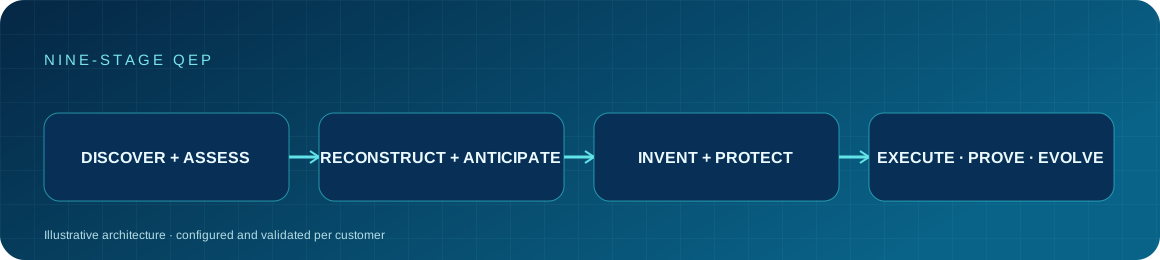
Explore the nine-stage QEP
A conceptual interactive walkthrough using a critical service outage.
One workflow, many industries — explore details
One workflow, many industries
The same controlled lifecycle can apply to different operational contexts.
Education
Identify an attendance trend, assess causes, propose support, obtain approval, verify improvement.
Healthcare
Identify scheduling capacity risk, model alternatives, approve a change and verify service impact.
Manufacturing
Detect an equipment anomaly, anticipate downtime, authorize maintenance and verify restored output.
What the nine stages mean for your organization
QEP is a decision-to-outcome operating methodology, not a software installation checklist. It describes how Ceryvra is intended to investigate conditions, plan and authorize action, verify results, and improve future responses. Execution occurs only at the appropriate stage and only when permitted.
Before execution
Discover and assess the situation; reconstruct relevant history; anticipate consequences; invent workable alternatives; and protect against unacceptable risks.
During execution
Approvals and permissions determine what may run. Execution is tracked against explicit conditions and acceptance criteria.
After execution
Prove the outcome using independent evidence, then evolve organizational knowledge only through governed learning gates.
Example: IT outage
A service outage triggers impact analysis, restoration options, change approval, execution tracking, service verification and documented lessons learned.
Example: Education
A pattern of missed interventions prompts review of source data, staffing constraints, possible responses, authorized changes and verified follow-up.
What a complete QEP cycle looks like for a customer
Consider a critical service interruption. Ceryvra would discover the signal and assess severity; reconstruct the likely event sequence and anticipate downstream effects; invent practical restoration alternatives and protect against policy, security or safety violations. Only appropriately approved changes would execute. Independent checks would then prove whether service was restored, while verified findings could inform future decisions. This is a conceptual workflow, not a claim that all integrations are currently live.