
One platform. Connected intelligence.
A shared operating architecture for evidence, reasoning, controlled action, verification and organizational learning.
From signals to outcomes
Ceryvra is designed as a coordinated system rather than a collection of disconnected copilots.
Knowledge foundation
A centrally curated, source-backed industry foundation is planned alongside isolated tenant context.
Reasoning & foresight
Use decision context, consequences and uncertainty to propose actionable options.
Authorized execution
Actions are subject to policies, approvals and bounded connector permissions.
Independent proof
Success requires observable evidence beyond an action reporting completion.
Recovery & obligations
Track unresolved failures, required repairs and outstanding evidence.
Verified evolution
Govern how actual outcomes update organizational knowledge.
The platform architecture — explore details
The platform architecture
A modular approach designed for reuse and tenant-specific configuration.
Core architectures — explore details
Core architectures
Click through the technologies and their practical purposes.
One intelligence foundation. Adaptable capabilities. — explore details
One intelligence foundation. Adaptable capabilities.
The UME is designed to compose authorized capabilities for different sectors and customers without uncontrolled changes to the underlying application.
Shared intelligence foundation
Reusable reasoning, evidence, decision, execution and verification components.
Isolated organizational context
Customer-specific permissions, knowledge, history and policies remain separated.
Controlled composition
Assemble sector-specific workflows from approved capabilities and integration contracts.
C‑E‑R‑Y‑V‑R‑A — explore details
C‑E‑R‑Y‑V‑R‑A
A customer-facing way to explain the journey from operational signal to verified improvement.
Capture
Gather authorized signals and evidence.
Evaluate
Assess reliability, relevance and constraints.
Reason
Explore scenarios and consequences.
Yield
Form actionable recommendations.
Validate
Check approvals and safety boundaries.
Reconcile
Compare actual results with expectations.
Advance
Preserve verified learning and improve.
Controlled execution — explore details
Controlled execution
The intended execution architecture introduces explicit safeguards.
Authority first
Use approvals, delegation and entitlement checks before sensitive actions.
Execution leases
Bound actions to valid conditions and prevent conflicting or stale operations.
Independent closure
Verify observed state rather than relying solely on an API success response.
Minimal repair
Prefer targeted compensating actions where safe and appropriate.
Recovery obligations
Keep unresolved restoration and verification work visible.
Learning gate
Only approved, verified outcomes should influence organizational memory.
Explore the architecture in depth
Every module serves a specific purpose within one controlled platform.
Decision Genome
A structured record of why a decision was made: source evidence, context, assumptions, risk, approvals, changes and actual outcomes.
EFAR
Evidence-Conditioned Future Action Reconciliation re-evaluates planned actions when new evidence, policy or operating conditions appear.
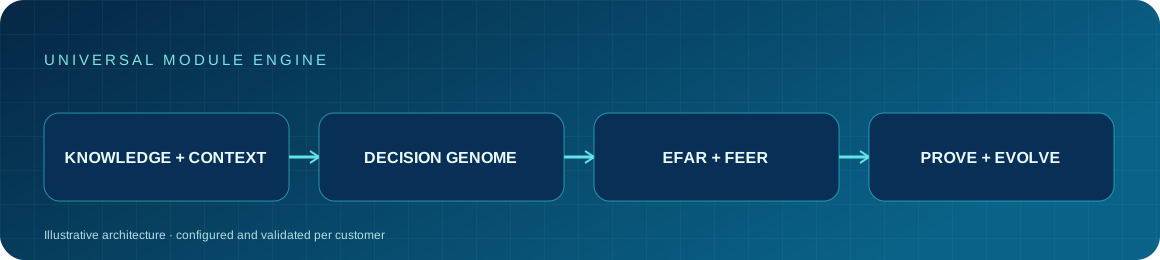
Universal Module Engine
A shared foundation designed to compose sector-specific workflows, with tenant-specific configuration, permissions and isolated organizational knowledge.
Consequence Graph and Firewall
Map downstream dependencies and evaluate policy, financial, safety and operational constraints before execution.
Recovery and Verification
Track execution obligations, reconcile actual state independently and manage repair or compensating actions when intended results are not achieved.
External Verified Learning
A centralized source-backed knowledge acquisition design, separated from customer-private learning and subject to verification and controlled synchronization.
FEER — reopening a decision when evidence changes
FEER is Ceryvra’s evidence-driven re-evaluation architecture for decisions whose supporting facts, policy versions or obligations have changed. Rather than assuming an old approval remains valid, the system is designed to identify affected decisions, preserve the original record, open a review obligation and route the change through appropriate authority. FEER complements EFAR: FEER revisits the evidence behind prior decisions, while EFAR reconciles intended future actions against current conditions.
UME — what customers actually receive
The Universal Module Engine (UME) is the proposed shared intelligence and orchestration foundation. It brings together Decision Genome, evidence obligations, QEP, EFAR, FEER, consequence analysis, governed execution, verification and learning under tenant-scoped policies. Customers would see industry-specific workflows assembled from approved capabilities, not an unrestricted AI that rewrites production software.
From evidence to verified organizational action
Ceryvra's Universal Module Engine (UME) is designed as a common orchestration layer, not a collection of unrelated industry bots. The platform uses governed knowledge and customer-specific permissions to reason about operational needs and compose bounded workflows.
Decision Genome — preserve the full decision context
Links a decision to supporting records, assumptions, policy versions, authorized participants, alternatives and anticipated consequences. When evidence changes, the organization can identify which past decisions may require review instead of restarting every investigation.
EFAR — reconcile future actions with new evidence
Evidence-Conditioned Future Action Reconciliation evaluates whether an approved or planned action remains appropriate when dependencies, risks or operating conditions change. Proposed changes can be paused, revised or reapproved rather than blindly executed.
Verified learning and tenant memory
A centrally governed, source-backed industry knowledge foundation is planned alongside private customer knowledge layers. Ceryvra is intended to distinguish externally verified information from local organizational experience and to admit new learning only through controlled evidence and approval rules.
Recovery and independent verification
After an authorized action, independent observations are compared with explicit acceptance criteria. Failed or uncertain results create remediation or recovery obligations; an execution log alone is not treated as proof of success.